
At the Café Le Rendez-vous des idées · Literature and philosophy
A letter from Karl, the old Berliner
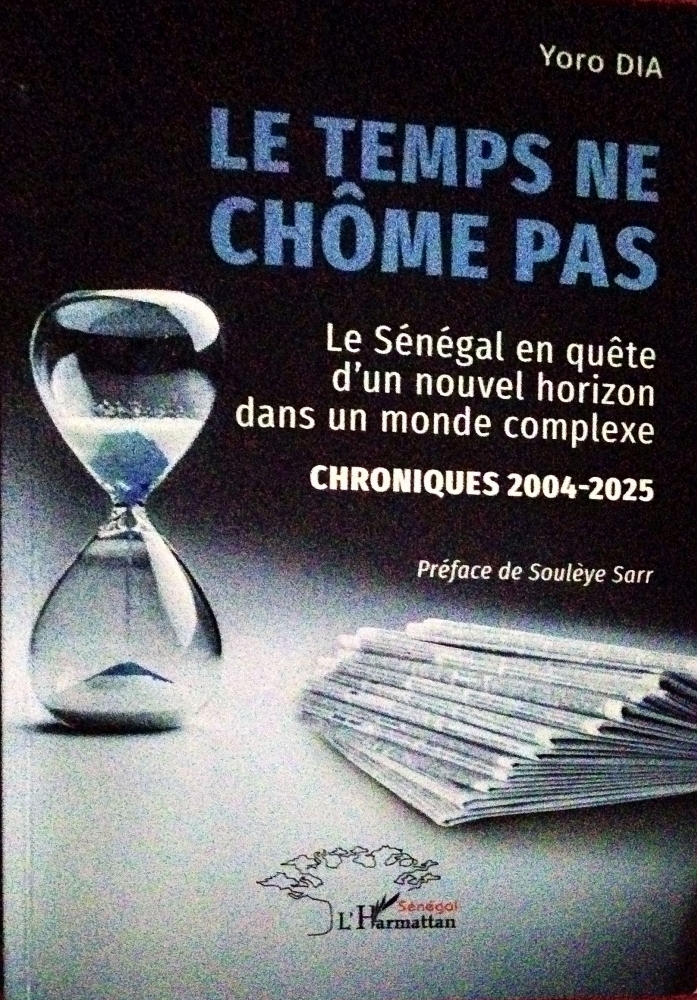
To mark the publication of Yoro Dia’s Le temps ne chôme pas. Le Sénégal en quête d’un nouvel horizon dans un monde complexe, a collection of columns written between 2004 and 2025, Le Rendez-vous des idées presents a new letter from Karl, the old Berliner. Taking as his point of departure the dedication to Mamadou Bassirou Kébé, founder of AÏWARA, Karl reflects on historical time, the craft of political commentary, national memory and the responsibility of peoples confronted with history’s missed appointments. The book will be presented at L’Harmattan Sénégal on 19 September 2026.
Some books do more than comment on current affairs; they remind nations that time keeps moving even when peoples linger amid noise, illusion and missed appointments with history.
Berlin, 14 September 2026
Dear Yoro Dia,
Bassirou arrived at the Café Le Rendez-vous des idées with your book under his arm, like a man entering a room with a witness. He did not place it on the table as a ceremonial object, but as quiet proof that words, when they outlive the news cycle, eventually become travelling companions. On the cover were an hourglass, newspapers, your name and a title that begins its work before the first page has even been opened: Le temps ne chôme pas — Time Does Not Stand Idle.
Then he read your dedication. I heard it from Berlin, in that brief silence which old friendships impose upon men who have seen too much to be loudly moved:
“To my friend and brother Bassirou Kébé, whose friendship with me cannot be summed up in a single letter from Karl.”
You are right. No letter can ever contain a friendship. It can, however, give it form, offer it a lamp and shelter it from the haste of passing days.
That is why I am writing to you. Not to answer one courtesy with another, but because your book appears to belong to that rare family of works which ask for more than a launch, a reading and applause. They ask to be contemplated. The event scheduled at L’Harmattan Sénégal on 19 September 2026 should therefore be more than a literary gathering. It could become a moment of national conversation, provided that we take your title seriously.
Time does not stand idle. The phrase is brief and sounds almost familiar. Yet it contains a gentle warning. It tells us that peoples may become distracted; governments may postpone reform; oppositions may turn hope into turmoil; intellectuals may defer courage until tomorrow. Time, however, continues its course. It takes no leave. It wears down slogans, catalogues promises, tests programmes, exposes imposture and preserves in its silent archives everything that human beings believed they could forget.
When a newspaper column is weak, it ages faster than the paper on which it appeared. When guided by genuine political intelligence, however, it survives the next day. It becomes less a commentary than an act of vigilance. It observes the event without bowing before it and refuses to confuse the dust of the day with the deeper movement of a country. By bringing together columns written from 2004 to 2025, you offer more than a succession of texts. You invite us to reread over twenty years of Senegalese history as one might examine the health record of a Republic.
Fernand Braudel helps us understand your undertaking. Events make noise; structures work in silence. A scandal passes. A change of government passes. Anger passes. Yet the inertia of the education system, economic fractures, institutional fragilities, the Casamance question, a generation of young people without an adequate horizon and Senegal’s place in the world continue to work beneath the surface. The serious columnist is not the one who chases every wave, but the one who discerns the current.
Your subtitle speaks of a Senegal in search of a new horizon in a complex world. The word “horizon” is not innocent. Reinhart Koselleck might have said that a nation always lives between a space of experience and a horizon of expectation. It carries what it has endured and moves towards what it still believes possible. Yet when experience no longer produces lucidity, the horizon deteriorates into a poster. Dawn is promised without a road being built. Change is celebrated without habits being transformed. Rupture is confused with the noise it makes.
This may be one of Senegal’s central questions. We have accumulated political experience. We have witnessed democratic alternations, broken loyalties, popular enthusiasm, disillusionment, grand narratives of modernisation, calls for sovereignty, social tensions and democratic impatience. But have we sufficiently transformed this experience into national intelligence? Have we learnt to draw lessons, or merely to change sides whenever the last one disappointed us?
From Berlin, this question is familiar to me. Germany knows that time can judge distracted peoples harshly. It also knows that culture, philosophy and science do not invariably prevent catastrophe when political vigilance falls asleep. In the book’s preface, I was pleased to encounter the names of Fichte, Schelling and Hölderlin. Yet the Germany of the philosophers also teaches us a harsher lesson: thought becomes useless when it consents to arrive too late.
Your book seems determined to resist that delay. It travels from Senegal to the wider world and back again. Saint Augustine, Afghanistan, China, the United States, Russia, Africa, Mali and Casamance are not decorative references. They remind us that Senegal does not inhabit a sealed room. The world moves, powers advance, borders tremble, democracies doubt, young people demand, economies impose their verdicts; and peoples absorbed in secondary quarrels often discover that history has changed seasons without waiting for them.
Here your title becomes almost a lesson in citizenship. Time does not stand idle, and neither should the Republic. It must think, anticipate, educate, produce, protect, arbitrate and transmit. It must resist the easy allure of spectacular new beginnings. Senegal needs more than an alternation of faces. It needs continuity of purpose, an economy capable of sustaining its youth, institutions that withstand changing moods and a public discourse that does not exhaust the country before it has begun to serve it.
I do not yet know which columns readers will remember most. Some will turn to the democracy of Sisyphus, others to the complex world, still others to Casamance or geopolitical realignments. The point of entry matters little. A good book is a house with several doors. What matters is that each leads to the same question: what are we doing with the time we have been given?
Thank Bassirou, then, for bringing your book to the Café Le Rendez-vous des idées. He has introduced it into that imaginary place where ideas come not to display themselves, but to work. And accept, dear Yoro Dia, the gratitude of an old Berliner whom your dedication has touched without softening his judgement. One letter from Karl is not enough to sum up a friendship, you say. Perhaps not. But it can at least acknowledge this: when two men still believe that books can help a nation find its way, their friendship becomes a way of serving the Republic.
Time does not stand idle. It is for us to ensure that it does not work against Senegal.
Karl, the old Berliner